-
Enjoyment
I was playing basketball the other day, and it dawned on me… there are very few things I do purely for enjoyment.
I was there on a Sunday afternoon by myself in an empty, underutilized beautiful hardwood court. No one had to convince me to play. I didn’t have to force myself or tell myself anything. The fact that I was alone didn’t bother me one bit. But in other areas of my life or activities/tasks, I find myself having so much resistance.
In motivation literature, there’s a framework of intrinsic vs. extrinsic motivation.
- intrinsic motivation,’ motivation from within where people do an activity because they enjoy it and get personal satisfaction from doing it.
- extrinsic motivation, where people are motivated by the outcome that will result from doing the activity.
I don’t have many things in life I do for pure enjoyment. Everything has an “in order to.” Or perhaps I start things for enjoyment, but in seeing any activity or project to fruition, my motivation shifts extrinsincally.
I play basketball for enjoyment. I used to take boxing fitness classes for pure enjoyment. Some workout classes were so fun and pleasant that I’d take it for enjoyment too.
What do you do purely for enjoyment?
-
“How to pick your life partner”
“How to Pick Your Life Partner, Part 2” written by Tim Urban for his blog, “Wait but Why”, from 2014 still resonates with me today. It’s one of my favorite posts. I revisit it from time to time.
He writes about how “a great achievement is just what a long series of unremarkable tasks looks like from far away” and compares that with happiness, “that achieving life happiness was all about learning to be happy on a routine Wednesday.” He applies that idea to marriage: “from afar, a great marriage is a sweeping love story, […but] marriage is a forgettable Wednesday. Together.”
He continues to write: “to endure 20,000 days with another human being and do so happily, there are three key ingredients necessary:
- An epic friendship
- A feeling of home
- A determination to be good at marriage.”
Most of the people in my life have already picked their life partners. Many of friends, colleagues, and extended family members are in long-term partnerships or married with children. While I sometimes I get tempted to emulate what they’ve created, I also remind myself to start my own model of long-term partnership and marriage. Having read a lot of material on the topic, I can say, I do aspire to have an epic friendship, create a shared feeling of home, and continued determination to be good at marriage and be a great partner.
-
Being a better listener (and dinner date! and work colleague!)
“The greatest compliment that was ever paid to me was when someone asked me what I thought, and attended to my answer” – Henry David Thoreau
I’ve started dating again, after a 7-month self-imposed break since my last break-up. But I’ve noticed a bad habit – after the first couple dates, I stop listening.
Instead of listening, I start quietly judging the other person and get preoccupied, letting my thoughts wander and wondering to what extent would this person be a good match for me.
Even at work, my conversations are missing the kind of back-and-forth flow, but rather are hurried and maybe even borderline transactional. I rush to get off the call, in part of based on the principle of ending on time. But the conversation then is missing the kind of spaciousness and a sense of time and leisure that results in a sense of connection.
That’s not how I want to show up in life. I love intimate conversations, of feeling connected to another human, whether it’s for a moment of eye contact, transfer of energy, of insight, of life stories, of smiles, of smiles with eyes… I mean, it’s the absolute best.
I aspire to listen curiously, openly, generously. I have and I can.
I want to be truly present and give the person sitting across from me my undivided attention. I want to be fully listening to his or her experience, words, thoughts, feelings… rather than listening to my thoughts about what they are saying.
I’ve felt highly annoyed with myself in this recent spurt of dating, almost driving me to consider walking away from it cold turkey, in part because dating has felt all-consuming and is also forcing me to confront my own flaws. But I guess in a way, it’s also nudging me and giving me an opportunity to grow.
[Hm, I wrote this as my paragraph per day, but might delete later.]
-
A paragraph a day?
There’s so much I want to express, but attempting to capture everything at once seems overwhelming, in both written and verbal communication. So the outcome tends to be binary – either I don’t start/say anything or end up ‘dumping’ in the form of freewriting or even worse, “word vomitting.”
I used to be so scared of writing and being public about my thoughts – and associate thoughts with my name, but since no one knows about this blog, it’s been refreshing to just write and hit the ‘publish’ button.
A few recent thoughts of stuff I want to write out:
- Recent trip to MoMA – and cognitive dissonance after finding out details of recent construction (costs, merger/destruction of American Folk Museum)
- RAS
- All kinds of stuff on dating
- The kind of world I *do* want to live in
- What I never said/wrote about AAPI violence – and the ways DJT used social media platforms to normalize the systemic dehumanization of and violence towards Asian Americans
- Embracing being Korean / on identity / that I can’t outrun racism with accomplishments
- The stuff we’ve been talking about on our podcast (about not being the perfect Asian daughter – beauty standards, family expectations, career development tips, saying ‘no’, etc.)
- On whistleblowers
- Impatience for ‘social change’
- What’s broken with philanthropy, big tech, regulation – and why it matters
- The open letter on ‘pausing development on AI’ and the business interests behind the plea (disguised as wanting to mitigate social harm)
- The amazing run that the Sacramento Kings had – and why I’m inspired and rooting for them. And on a separate note KD and his comments on ‘legacy’
Recent realizations
- Erasure of people of color in tech is real. While the ‘news’ moment has passed, I was part of the history of the 2020 election cycle, Jan 6th, and more while at Twitter. No one is going to tell my story for me. I used to think it wasn’t important and it was easy to diminish my experience – and was concerned that cost of telling it would be too great. But I am seeing an opening, a pathway, something new that’s possible, and a desire to tell my story and create initiatives!!!!
- It’s also been hard to be a bystander, in the bleachers, watching others take credit for work that wasn’t theirs or make uninformed recommendations that are rooted in their imagination rather than experience.
- While ‘tech ethics’ was satire on episodes of HBO’s Silicon Valley tv show, “tech reform” / “tech policy” has become an extremely crowded space. I’m not sure if the activity is driven by demand or supply, but one thing is true – there’s a lot of noise.
- I’m personally ready. I’m mentally, physically, emotionally getting into ‘fighting shape.’ I was able to take off – and I’m so grateful for having that privilege (and trusting my instinct to run down my personal savings to do so). I’ve also had some distance from the trauma of being responsible or involved in high profile content moderation decisions that were not only personally distressing, but also globally impactful.
Maybe I can start out with a paragraph a day, even if it’s a halfbaked thought, maybe 10-30 minutes a day. 🙂
Food for thought – Is there anything YOU wish you could do everyday? Anything you want to write about? Want to express?
-
Innovation in the actual balls used in sports
I love basketball. I enjoy playing basketball, even just shooting a basketball on my own. The sound of a swish, the release of the ball from my fingertips, making corrections to my form, it all is really satisfying. As I moved from city to city, I tried to find a court, but I remember a basketball being kind of bulky to take while moving.
Why is there not really innovation in basketballs? Why are basketballs so expensive? Why hasn’t there been a new brand?
I have a really old ball, tattered, and kinda hard to shoot around with, so I went on Amazon to buy a new one recently. Wilson is now the new brand of the NBA. I remember Spaldings used to be the standard; There were no-name basketballs, made in China or without a brand that I recognized. I was unclear on quality, but I knew I was paying up for the brand. I remember having a ball when I was a kid with David Robinson’s signature on it and thinking it was probably the cheapest one available at Toys”R”Us; I remember not wanting to ask my parents for a Spalding.
My new, nice $53-dollar Spalding ball (React TF-250 Indoor-Outdoor) now sits in my home, and has a really odd smell when I walk by it. Like a deep, whisky-like incense, a burning kind of smell. It’s barely pumped, so its crumbled up.

I wonder if there’s supply chain innovation that’s waiting to happen, like how Warby Parker unseated Essilor Luxottica by manufacturing and going direct-to-consumer without the middle-man mark-ups.
Who is manufacturing basketballs? In what factories? From what materials? And why do they smell like shit? I mean, seriously. That can’t be good.
I remember Jessica O. Matthews invented Soccket, an energy-harnessing soccer ball for her company Uncharted Play. I remember recently getting served advertisements on Instagram with girls bouncing a basketball ball that can connected to an app that will help me train and adjust my dribble.
What if there was a high-quality, foldable basketball that’s cheaper and better for the environment? Foldable means easily portable. What if it could also just inflate on its own within without needing a pump? What if there’s one that’s high quality and feels like leather, that is not harsh on your hands and has a great bounce?
Next steps?
Haha maybe I’ll start a Kickstarter. Maybe I can find an inventor. Do research. Maybe we can donate – like Bombas does for socks one ball – for every ball sold, one donated to a third world country or even an elementary school in a low-income neighborhood. I mean, what balls are being used in gym classes anyway these days?
Who cares?
Sports are so important for kids, even adults. One ball, one basketball, one soccer ball, can be enjoyed by an entire community for hours. One ball can keep a kid company for hours as the kid practices to pass the time, while waiting for parents. Sports create confidence, teach teamwork, and arguably have changed many lives. While sports is now primarily monetized and a source of media/entertainment as a likely trillion dollar industry (especially when you include leagues, broadcasting rights, clothing/shoes, and betting), there’s a joy to playing, particularly in childhood.

If I actually do this…
Damn, this would be fun and potentially profitable with a social mission/impact and be aligned with my values. think this is something a lot of people and stakeholders can get behind. There’s something universal about sports. And within sports, a specific, niche problem area/space.
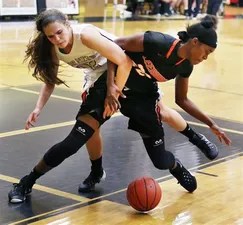
Basketball has been a simple joy in my life, since I was a kid. I was never that good, never played on an elite level, but it’s something I’ve deeply enjoyed. In the pandemic, it was the one activity I did outside when things were opening back up again and I was so grateful for the one rim/hoop that wasn’t clipped in my neighborhood. As an adult, I’ve somehow forgotten or subconsciously suppressed my hobbies, but recently, started to listen to myself.
I love thinking of new business ideas, talking about them with friends. But it’s a matter of, which make sense enough to pursue. Even if it fails, it’s still worth taking it to the next stage to see. Having done two businesses before, I’m much more at ease with experimentation.
Food for thought:
- What is your connection to sports? What are you passionate about? Why?
- Are there any childhood hobbies or new hobbies you want to explore now as an adult? How much joy would 10 minutes of playing that give you?
- Do you have any insights or want to get involved? Anyone you can make an intro to that would want to contribute in some way? Do you know any inventors, manufacturers, people involved in the sports business?
- If you were me, what questions would you have? What do you see are the riskiest assumptions?
- Who do you think could benefit from cheap, high-quality basketballs?
-
2023 goal setting
DAMNNN, it’s already mid-March 2023!
I know I haven’t posted for four months since November 2022! Coincidentally, it’s also when I started working near full-time again. Now that Q1 of 2023 is nearly over, it’s the perfect time to revisit progress towards this year’s goals.
Do you set New Year Resolutions? What goals do you have for 2023? Do you use any frameworks or tools to provide structure to create and review goals?
Over the years, I’ve liked the following:
- for annual introspection and next-year planning: Year Compass (and other year-in-review frameworks and visualization prompts)
- for daily gratitude/logs: 5-min Journal from Intelligent Change
- for daily/weekly action steps: Productivity Journal from Intelligent Change
- for short-term projects: 12-Week Year
- for review on areas of life you care about: Wheel of Life
- for breaks: Pomodoro Technique (work for 25-30 mins, then take 5 min break)
- for motivation: create rewards, write things down, share with others (and report completion, with photos too if that helps), do together virtually (‘body doubles’ or ‘integrity hours’)
I haven’t kept up with using bullet journals, the SELF journal, or to-do managers.
Moment of reflection: My goals for this year are somewhat straightforward (and dictated for me) in the area of career/wealth generation and romantic partnership/family planning – but it seems weird and ‘real’ to be posting them in more specificity, even though no one knows about this blog and I have not publicly associated with real name with this blog. There’s certainly power in being specific and public about one’s goals, which I haven’t been yet, but will be soon!
I feel like I’m figuring out where I’m headed, as I take one action, one step forward each and every day. While it’s nice to have lofty goals, I’m realizing it’s nearly impossible to have everything figured out. Instead of trying to map out the future beyond broad strokes, I can focus on (1) taking consistent action, (2) identifying the most important action to take, and (3) staying encouraged and patient, while being rigorous about revisiting where I’m at in the process.
-
Wow, I love boxing
Wow, I’m hooked.
I just finished a one-on-one boxing session with a trainer at a nearby park.
I loved it.

It was such a great workout.
He had me jumping rope, taught me how to punch, and doing sit-ups to punch up with gloves. I was in a semi-squat position for most of the hour. I was also moving and engaging muscles in ways I normally don’t. It was also challenging to keep my core engaged, while keeping my shoulders relaxed.
I had so much fun.
I learned a lot in an hour. Everything about it was new. The stance. The counts. The combinations.
When the trainer started talking about the “2” punch being my “bread and butter,” I couldn’t help but laugh that this former boxing competitor is training little ol’ me.
I started to catch what I was doing incorrectly and attempt to self-correct. With little tweaks to my form, I could immediately tell the difference in my punches. I could start to feel the power in my punches. It was a really satisfying feeling when my glove properly connected with the mitts he was holding up. I wasn’t focused on punching hard because I wanted to get my form down, but I could definitely see why “fitness boxing” aka boxing for the workout is a great stress reliever and way to release tension or frankly anger or aggression.
In today’s session, I also noticed there’s a certain elegance to boxing. I assumed boxing is done via brute force, but there’s more to it than meets the eye.
I got so much positive reinforcement in a short period of time.
The trainer seemed very professional and trustworthy based on the reviews I read that were left by women who trained with him. I expected him to be nice, but I didn’t expect to walk away feeling so…positive.
He gave me lots of encouragement: “there it is. there you go.” I couldn’t help but smile at times and thought to myself, “I don’t think I’ve ever gotten that much positive reinforcement in 60 minutes.” I tend to have negative self-talk, so to experience the radical opposite was an experience in and of itself.
What now?
I’m surprised that I liked it so much and that I picked it up quickly. I can now do a jab, cross, and left hook. I can’t wait to train again. I need to figure out a way to keep the sessions going (and budget for and pay for them).
I’m excited to learn more – and find other outlets. I know Rumble has boxing-inspired classes and found the SF Boxing Club offers outdoor group classes. I’m keeping an eye out for boxing gyms to join with a friend in the future.
I know it’s too early to tell, but I may have found something I really enjoy. Building strength and endurance are my main fitness goals, in addition to shedding my pandemic weight. I’m inspired to do other workouts to get fit and strong and get better at this boxing thing. 🙂
-
Election Day
For a state that values data privacy, California should offer voters the right to keep their contact information and voting history private.
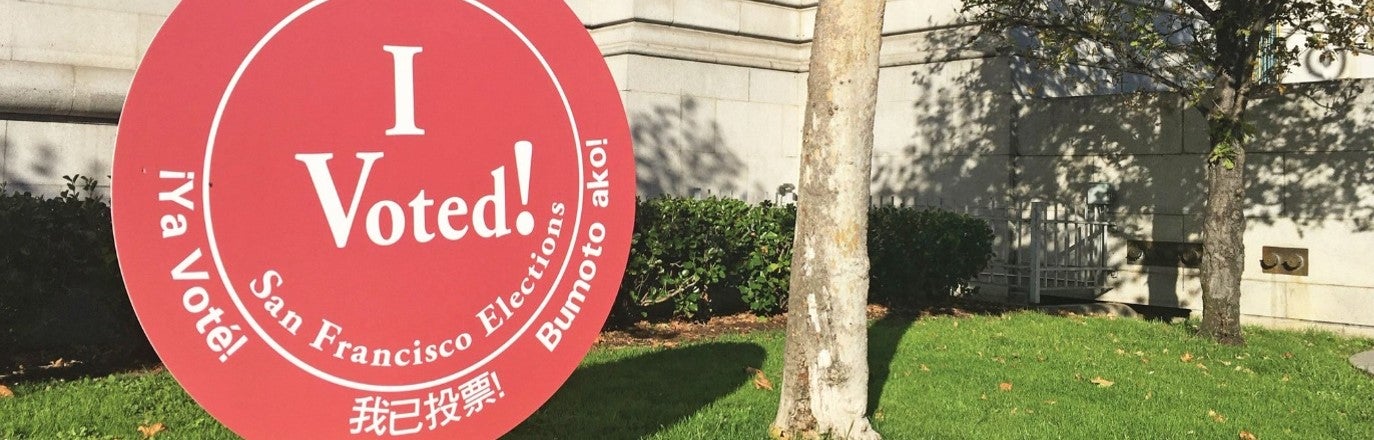
Courtesy of SF Board of Elections The privacy problem
This election cycle, I received a noticeable increase of mailers, text messages, and emails from campaigns. In San Francisco, there were 22 propositions on the ballot and several tight races, so campaigns were busy targeting and persuading voters.
Little did I know that the state was sending “my email address, and phone number, along with my address and party affiliation” to campaigns, according to an investigation conducted by Geoffrey A. Fowler, a columnist for the Washing Post.
While I may have offered my email address and phone number voluntarily when registering to vote, I never consented to that information being shared to other parties. Was there a piece of fine print that I missed?
The state is sharing this information to “campaigns, parties, academics, and journalists (and the companies that help them)” without my consent.
My physical address is considered sensitive location data, a critical piece of personally identifiable information (PII) that I work hard to keep private. I pay for a virtual mailbox / forwarding address and to have my information removed from data brokers, whose business model it is to find, capture, and sell my contact information and location data.
The alternatives
There’s no easy to way to prevent the state from making my voter information and history semi-public record. My current options to keep part of my voter file confidential are:
- Have all of my mail be forwarded to a different address if I am eligible for the Safe at Home program that helps victims of domestic violence, sexual assault, stalking, or human trafficking as well as reproductive health providers keep their address confidential if they believe their life is at risk
- Have a court order that requires keeping my residence address, telephone number, and e-mail address confidential after “showing of good cause that a life-threatening circumstance exists to the voter or a member of the voter’s household”
- Re-register to vote (without providing my phone number or email address) but still have no control over my physical address from being shared
Why must my life be in danger for me to opt-out of having my voter file be shared?
An opt-out function and greater transparency
The state should provide the option for everyday residents to opt-out of their personally identifiable information from being shared.
The government of California passed the California Consumer Privacy Act of 2018 (CCPA) to “give consumers more control over the personal information that businesses collect about them.”
The Attorney General’s office website explains that “this landmark law [CCPA] secures new privacy rights for California consumers:
- The right to know about the personal information a business collects about them and how it is used and shared;
- The right to delete personal information collected from them (with some exceptions);
- The right to opt-out of the sale of their personal information; and
- The right to non-discrimination for exercising their CCPA rights.
Businesses are required to give consumers certain notices explaining their privacy practices. The CCPA applies to many businesses, including data brokers.”
Maybe the state should require providing the same level of notice and transparency to their citizens about privacy practices of their own.
Thinking ahead
I relied heavily on using direct quotes and wrote in an op-ed style to make my point. I wrote this based on an hour of research, but I intend to research this topic further. Who does this impact? Has an opt-out function been proposed before? If you have any thoughts, ideas, or suggestions, please reach out.
As people hold their breath for the results, big thank you to the SF Chronicle and KQED for their excellent coverage, voter guide, and editorials to inform residents and readers in navigating the chonky ballot.
-
Innovation in DAFs
In 2015, Barron’s profiled Legacy Venture, a Palo Alto-based investment firm that uses money from donor-advised funds (DAFs) to invest in VC fund managers and then distributes returns from those VC funds to nonprofit organizations.
So to break this down:
- Legacy raises money from foundations and philanthropists – such as Pierre Omidyar and Jeff Skoll that were already earmarked for charitable giving in DAFs
- Legacy then invests in VC funds (such as Andreessen Horowitz, True, and Index, and Accel)
- These VC funds invest in portfolio companies (such as Airbnb, Crowdstrike, Dropbox, Facebook, Kuaishou, Linkedin, Netflix, Peloton, PinDuoDuo, Pinterest, Slack, Stripe, Twitter, Uber, VIPShop, Xiaomi, Zulily)
- The proceeds or returns from these VC funds then get distributed to charitable causes
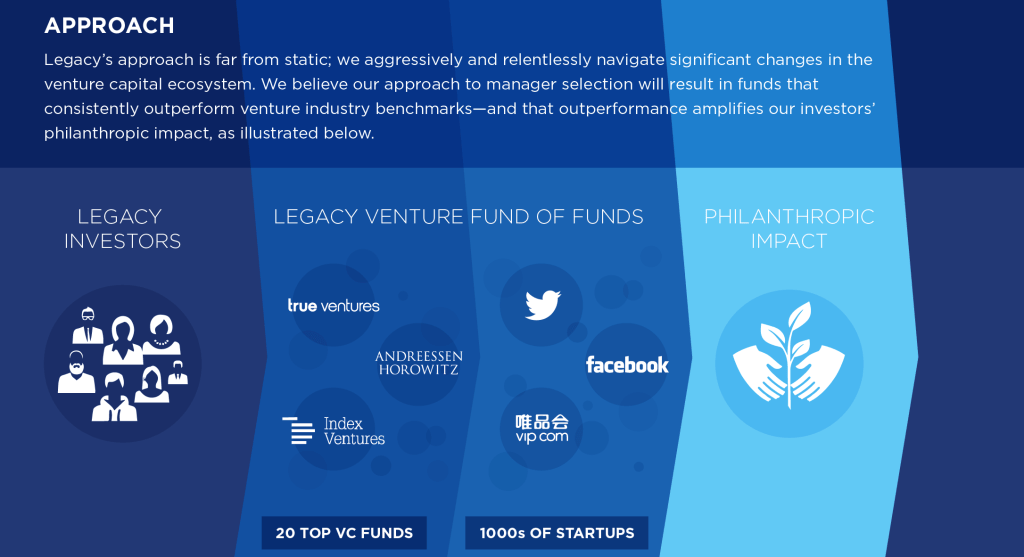
Legacy website, Sep 7, 2022 As of the 2015 article, their latest fund of $250m invested in 20 underlying funds. The minimum commitment was $1m with a fund term of 10 years. The management fee is 0.7% with 0% carried interest (whereas the industry FoF standard is 1%/5%).
Quick stats according to the company website:
- Founded in 1999 – by VC veteran Russell Hall, along with Jim Anderson; both worked at Merrill Pickard Anderson & Eyre – with $40m from Cisco VPs and VCs
- Over 600 investors/LPs – including 4 of the original 40 in the Giving Pledge
- Over $2b in distributions to causes
Opinion: This model of philanthropic giving is very interesting and innovative. There’s a flywheel effect of maximizing impacts across multiple stages and stakeholders. I believe this model can be useful not only to fund the next generation of underrepresented vc managers but also for climate strategies.
Fun fact
- The Barron’s profile used this word: el·ee·mos·y·nar·y: relating to or dependent on charity; charitable.
Questions
- Are there others that have adopted this model?
- If Legacy took carried interest, would it no longer be allowed to raise money from DAFs? Has the fee structure changed since Legacy has started? How does Legacy make money?
- Have they started co-investing alongside their VCs?
-
The Twitter Whistleblower
In this past week, on August 23, 2022, The Washington Post reported on a whistleblower complaint made by Peiter ‘Mudge’ Zatko, a former Twitter security executive, about Twitter. Here’s a WashPo gift link if you hit a paywall: https://wapo.st/3clFzg2.
WashPo also hosted a Twitter Spaces chat on the same day. I noticed several former and existing Twitter employees listening in. I found the commentary and reporting fascinating and fairly nuanced.
Mudge filed the complaint last month with the SEC, DOJ, and FTC. He alleges that “Twitter executives deceived federal regulators and the company’s own board of directors about ‘extreme, egregious deficiencies’ in its defenses against hackers and its ‘meager efforts to fight spam,’ among other issues.” As one would expect, Twitter has responded and denied these allegations by pushing back and claiming that the allegations are creating a “false” narrative.
I haven’t read through the complaint in full yet, but my initial reactions are:
- Feeling surprised – I didn’t expect someone of Mudge’s stature or level of responsibility at the company to be a whistleblower. The cognitive dissonance for me is that I have an image of whistleblowers resorting to whistleblowing and taking a matter public inside of a power structure/framework in which they do not have power; whereas, in this case, Mudge has a level of power and privilege that I don’t associate with most whistleblowers. I recognize this is my own bias – and I believe wrongdoing is wrongdoing, regardless of who calls attention to it, but didn’t he have the responsibility and the tools to fix things from the inside? Mudge was hired by Jack after the security breach in 2020, given his past expertise. I was there when Mudge was introduced at #OneTeam, the company all-hands. Wasn’t Mudge hired to fix the very problems that he outlines in his claim? When working there, I don’t remember hearing much from him after he joined. The docs reflect him proposing and leading a company-level initiative, but then he was eventually fired. Is this a case of a high-level executive whose scope was “XYZ” (in this case, security) to then turn around and say, XYZ (security) is broken at the company? I guess by being fired, he didn’t have the opportunity to work on it any longer, but how much did he actually influence or impact when he was there. Regardless, I do acknowledge that because the claims are brought forward by someone of his stature and reputation, people are taking it seriously and engaging with it.
- Feeling confused – I’m confused about Mudge’s incentive for this whistleblower complaint and what his intention is. What’s the intended goal he hopes to achieve? What is the ideal scenario he has in mind for Twitter’s users and Twitter as a company? What’s the end game here that he is hoping for? What does he believe an investigation or regulatory oversight/influence will provide?
- Feeling validated – I’ve been frustrated with my own ability to effect change at Twitter. But if an executive with built-in power, privilege, credibility, a specific mandate, and team/resources couldn’t impact material change, it puts into context the environment I was working in. No wonder aspects of that job were so hard, especially as a woman of color working directly or tangentially on the issues that Mudge outlines in his complaint, before he even joined, while in the middle of one global or internal crisis after another.
I may share observations and thoughts at later date, but I’m not sure if I want to invite any unnecessary attention to myself. I do think it’s worth speaking the truth – and speaking truth to power or setting the record straight, if there are egregious inconsistencies that will have negative and lasting impacts on issues or people I care about. In other words, it has to be worth it to speak up.
From my initial glance at the complaint, I can say, it’s not as black or white as either party contends – Twitter (its company officers, spokespeople, and employees) or Mudge (the complaint, him, and his legal team). I hope lawmakers and the general public can see through these sweeping statements made by both sides. I believe these high-level, sweeping, generalized allegations and denials/rebuttals miss the mark and won’t actually built credibility or trust. I will be paying attention, but have not yet decided what to do. Maybe as a first step, I’ll read through the docs. 🙂
-
Subscribe
Subscribed
Already have a WordPress.com account? Log in now.
 liz writes